


The Hunt for Rare Earths: LSU Minerals Analysis Could Help Secure America’s Tech Future
April 20, 2026
Only 30 of the 600 carbonatite formations worldwide contain enough rare earth elements (REEs), vital to electronics and defense systems, to make commercial production viable. Two confirmed locations lie in the United States, with exploration continuing. The U.S. must find new deposits of REE-containing minerals to secure its supply chain.
LSU has developed analytical procedures to identify, describe, and define REEs’ key physical, chemical, and structural properties, positioning the university as a potential service center for researchers and companies worldwide.
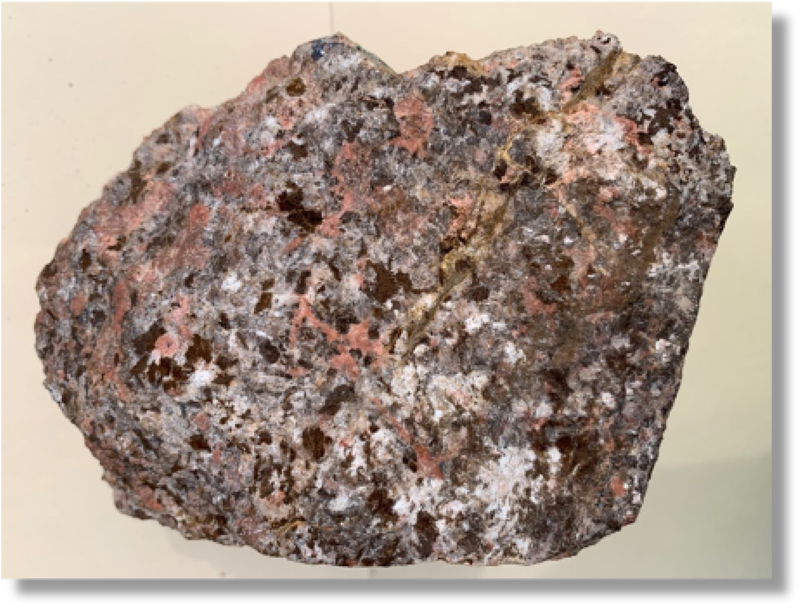
A piece of carbonatite from Mountain Pass, California, contains rare earth element minerals. The fleshy colored minerals are bastnäsite.
“Characterizing these minerals is critical to understanding where the REEs occur, in which minerals, and which REEs are present,” Geology and Geophysics Alumni Professor Barbara Dutrow said. “All of these issues have implications for mining, separation, and extraction.”
Dutrow’s research focuses on determining the REE contents of minerals found in carbonatites, rocks known to host a considerable amount of REEs, like the major deposits in Mountain Pass, California, and China’s giant Bayan Obo mine.
Using LSU’s electron probe microanalyzer (EPMA) in the Chevron Lab, Dutrow can perform chemical analyses on mineral grains just 5 microns wide, less than the thickness of a human hair. The EPMA reveals which rare earths concentrate in specific minerals like bastnäsite, parisite, and synchysite, and in what quantities.
REEs are critical minerals, indispensable to everything from wind turbines and electric vehicle batteries to refinery catalysts, defense guidance systems, and smartphones. China dominates the REE global market. The U.S. has made developing domestic sources and closing gaps in the supply chain – America lacks separation and processing capabilities – a priority.

Geology and Geophysics Alumni Professor Barbara Dutrow
“Finding new deposits is critical if the United States wants to become more energy independent and protect the supply chain,” Dutrow notes. “Being able to characterize these deposits and explore for them is a critical component of our national security strategy.”
Dutrow and Geology Professor and Chair Darrell Henry worked with LSU’s Advanced Microscopy and Analytical Core and EPMA Laboratory Director Matthew Loocke to develop analytical protocols and data reduction programs, some of them proprietary, to convert raw microprobe readings into precise chemical formulas for each of the elements.
One important step to better understand the minerals’ chemistry required normalizing the data, making sure the numbers and information are on a common scale so they can be compared accurately and avoid misleading conclusions. It sounds simple but required months of painstaking work.
LSU is one of the few universities to offer the service.
“We would like the world to come to us to have their analyses done,” Dutrow said.